Gau Mutra might or not warm Sadhvi Pragya's health, but is sure warming the environment. Holy Cow!
While cow's urine is claimed to cure cancer, science for certain establishes that the urine on degraded pasture is a major contributor to global warming.
The cow — and its urine — are touchy topics in India. We have extensive research, politics, controversies and debate to the claimed medicinal benefits of cow’s urine (gau mutra).
The latest, of course, is the cure of Sadhi Pragya's cancer.
The BJP candidate from Bhopal, who is also accused in the 2008 Malegaon blasts case, is a breast cancer survivor. "I was a patient of cancer and I cured myself by consuming gau mutra and panchgavya-mixed ayurvedic herbs," Sadhvi Pragya told India Today TV.
Sadhvi Pragya called the cure scientific, saying, "I am a living example of its effectiveness."
 "I was a patient of cancer and I cured myself by consuming gau mutra (cow urine) and panchgavya-mixed ayurvedic herbs," says Sadhvi Pragya. (Photo: Twitter/rahulkanwal)
Sceptical science
However, science is not convinced.
"Scientifically, there is no evidence of cow urine curing cancer. There may be anecdotal evidence — someone may say that he/she benefitted, but that is different. It has to be tested on patients," Dr Vikas Goswami, medical oncologist senior consultant at Max Super Specialty Hospital in Delhi reportedly told India Today. Dr Biswajyoti of Artemis Hospital, Gurugram is of the same view. "I have never prescribed cow urine for cancer. There is no record of patients getting cured after consuming cow urine or other cow products. We always prescribe allopathy treatment. Patients undergoing alternative treatment, in fact, have returned with a much worse condition that is inoperable," he opined.
Gau mutra = global warming, says science
What science does establish, though, is that cattle urine — especially when shed on degraded pastures, creates nitrous oxide — which has warming power far greater than that of carbon dioxide — the common metric for global warming emissions
This was according to a study conducted by the International Center for Tropical Agriculture (CIAT) and partners. The exact contribution of cow urine to the total nitrous oxide emission from India is yet to be estimated precisely.
The role of cattle and livestock as an important source of greenhouse gas methane has been established in past researches. However, this is for the first time that the role of cow-urine is being explored along the lines of global warming.
Before you raise those brickbats at us — or the study — the researchers clearly mention that the emissions can be significantly curbed by healthy pastures. Landscape restoration and conservation, therefore, are imperative. “When cow urine falls on degraded land, it releases far more nitrous oxide — a potent greenhouse gas — than when absorbed by healthy pasture,” says the release by Centro Internacional de Agricultura Tropical — also known as the International Center for Tropical Agriculture) or CIAT.
For the study, researchers collected urine from cattle at research sites in five countries across Latin America and the Caribbean. They spilled these 500 mL samples on paired cattle fields classified as degraded or healthy — which was determined by vegetation coverage. According to CIAT, degraded livestock land is generally characterized by overgrazing, soil compaction, loss of organic material and low levels of nutrients and soil carbon.
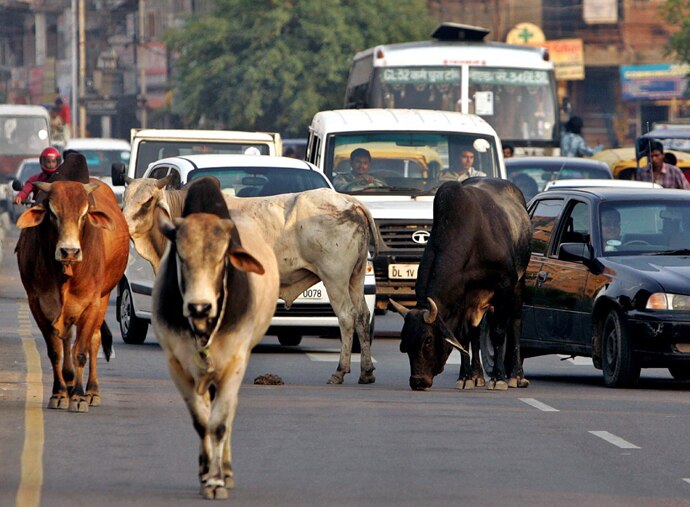 Abandoned Indian stray cows in search of greener pastures — from one to another. (File photo: Reuters)
In six of the seven test sites, degraded pastures emitted significantly more nitrous oxide — sometimes up to three times as much. The results were published in Scientific Reports, an open-access journal by the publishers of Nature.
Cow politics
The cow is a potently political animal in India. It’s urine — more so.
Sadhvi Pragya goes to the extent of enumerating the various health benefits of cow and cow products. She claims that rubbing a cow in a certain way can help one control their blood pressure. "If you rub gau mata from the back towards the neck she will be pleased. If you do it every day, your BP will stay in control," she said in an interview to India Today as she fed cows in a cattle shelter.
Explaining the cure in detail, Sadhvi Pragya said, "If you rub the cow from back to the neck, you will experience joy and the cow will also experience joy. But if you rub her from neck to back, the animal will feel uneasy. If you rub from back to front, your blood pressure will be maintained. This is Amrit (divine nectar). This is scientific. A gaushala (cow shelter) is the best place for Tapasya (penance)."
From urine-based soft drink, anti-dandruff shampoo, mosquito repellent, incense, tooth-whitening powder, all the way to the cure for cancer — cow’s urine has been tasted tested and vetted by Indian researchers for the tallest of claims.
However, what is irrefutable is that livestock — cattle in particular — forms the backbone of the agrarian Indian economy. It starts with cow’s dung and urine are mixed together for organic manure in Indian farms, goes all the way to milk being the largest crop in India economy. At Rs 6.5 lakh crore, milk is reportedly more than the total value of paddy and wheat put together.
India has the world’s largest livestock population. And also amongst the largest expanses of degraded land.
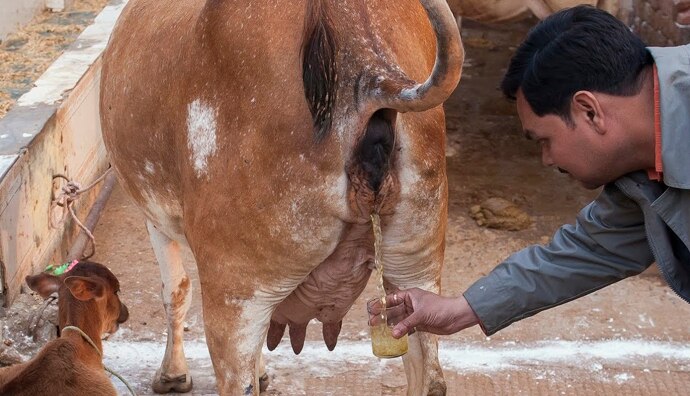 The wonder medicine that is sold at the price of milk in some Indian states. (Photo: YouTube Screengrab/ We Drink Cow Urine)
Mother cow treated like trash
The Ministry of Agriculture’s Livestock Census estimated the total cattle population in India (as of 2012) at 190.9 million. Of this, adult cows were numbered at 76.7 million. According to the results of a project in 2016 by ISRO’s Space Applications Centre in Ahmedabad, during 2011-2013, the most recent time period to be quantified, 29.3 per cent of the country was undergoing land degradation. A 2018-study by The Energy Resources Institute (TERI) commissioned by MoEFCC conservatively appraises the annual economic loss due to degraded land and change in land use at Rs 3.17 lakh crore (USD 46.90 billion) in 2014-15. This is 2.5 per cent of the country’s gross domestic product (GDP) in 2014-15.
The study’s lead author and CIAT researcher Ngonidzashe Chirinda says, “Degraded pastures are bad in so many ways. This study adds to the case for land restoration. Degraded pastures not only affect food security and the livelihood of farmers today but affect the livelihood of future farmers because they emit more gases that cause global warming.”
Cancer cure or not, the saffron brigade of Indian politico has been actively vigilant on cow protection, addressing the cow as "mother". Sadhvi Pragya, in fact, says that "Godhan amrit hai (owning cattle is like consuming divine nectar)."
However, it is not enough to call the cow one’s mother. It is important that the mother gets ample nutrition from healthy pasture lands and is not left orphaned on the busy streets of the metros.


Comments
Post a Comment