Trees resilient to climate change. Not to the axe
IUCN’s study provides practical guidance as to how to make rainforests more climate-resilient.
While carbon emissions continue unabated, here is some good news. If IUCN’s study is anything to go by, then all is not lost when it comes to combating climate change.
The international governing body of protected sites, in its report — Reforesting for the climate of tomorrow — analysed the traits of around 250 species of trees and other plants native to the rainforest of Kutai National Park in Indonesia and identified species resilient to the fires and drought conditions that are expected to increase as the climate warms.
According to a statement by IUCN, the climate change-resilient species included those with low sensitivity to changes, high capacity to adapt to them, or both. Two tree species that were singled out for their resilience to fire were a native palm, Borassodendron borneense, and the hardwood tree Eusideroxylon zwageri, known locally as Bendang and Ulin. The authors of the study recommend that these trees should be planted in buffer zones of forests — around the fire-prone areas to prevent wildfire outbreaks from spreading.
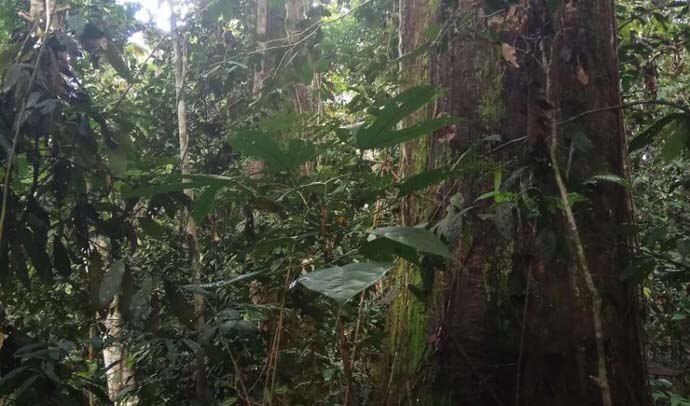 Ulin trees (Eusideroxylon zwageri) were recommended for reforestation activities in and around Kutai National Park due to their resilience to fire events and use by orangutans for building nests. (Photo: IUCN/Lita Kabangnga)
Acknowledging that the increasing drought and fires, caused by a warming climate, are among the most important emerging threats to species-rich areas such as Kutai National Park, the researchers warn that the trees will not nullify the effects of carbon emissions. According to Sandeep Sengupta, IUCN’s Climate Change Coordinator, “To halt the catastrophic impacts of climate change on nature we urgently need ambitious emissions cuts. But with climate change already impacting many species in alarming ways, nature needs all the help it can get in adapting to these rapid changes.”
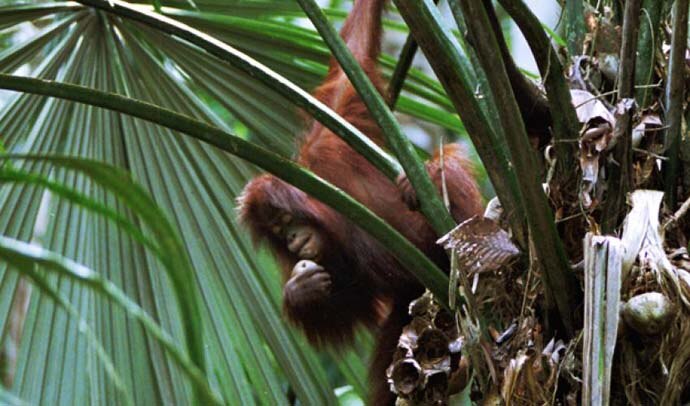 An orangutan eats fruit from the crown of a Bendang tree (Borassodendron borneense). (Photo: IUCN/Anne Russon)
Among the species, the authors also identified tree species that provide food and habitat for threatened East Bornean orangutans, for which the park provides a key habitat. Seven plants that are likely to be climate resilient emerged as key food sources for East Bornean orangutans. The researchers have recommended that these trees be planted alongside vines that the apes use for moving through the forest and trees which they prefer for nesting — such as the Ulin tree. To minimise conflict with humans (the biggest threat that the orangutans face) the researchers recommend planting these species in areas that humans are unlikely to access.
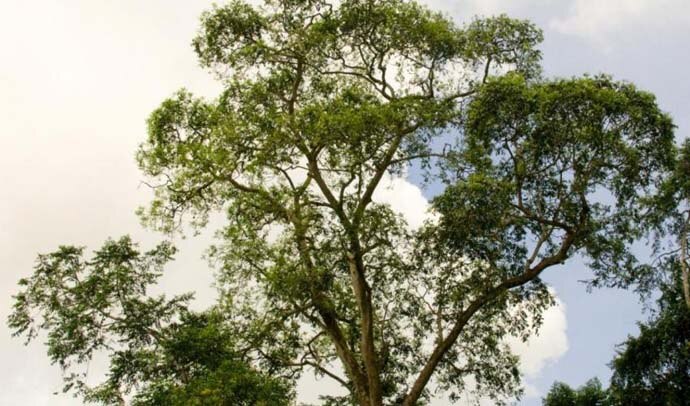 The Sengkuang tree (Dracontomelon dao) is an important orangutan food source that is vulnerable to climate change. (Photo: IUCN/ Anne Russon)
“Kutai National Park was once one of the most important lowland rainforest sites in Borneo, and its degradation is a major loss not only for Indonesia but for the world. But there is a glimmer of hope in that populations of threatened East Bornean orangutans persist there and work continues to restore forest cover in the park. Selecting which species to plant is a significant contribution to restoring the health of this ecosystem,” study co-author Douglas Sheil says.
Biodiversity in Kutai National Park faces multiple threats like population expansion into the protected area, hunting, fire, and coal mining, with climate change an important emerging threat. However, none of these is as major perils as deforestation and forest clearing in the region.
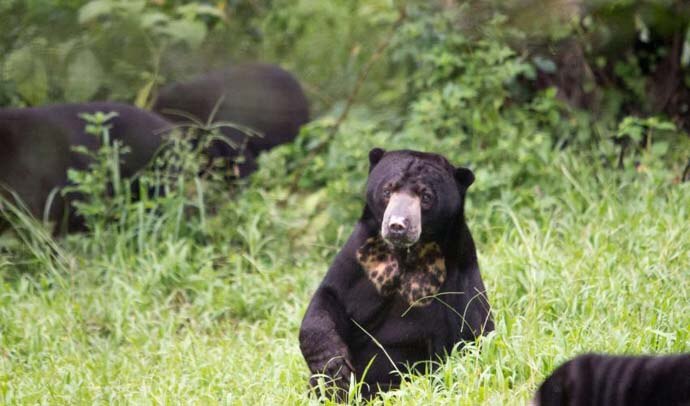 Kutai National Park protects a wide variety of wildlife from Malayan sunbears (Helarctos malayanus) to the Javan banteng (Bos javanicus). (Photo: IUCN/Alan Lee)
In the early 1900s, the total forest in the Indonesian archipelago (comprising of about 17,000 islands) was 84% of the total land area. This was the home to some of the most biodiverse forests in the world. However, in the early 1970s, Indonesia had started lopping its forests for the development of the country's wood-processing industries.
Between the late 1980s and 2000, the production capacity of the pulp and paper industries in Indonesia had increased by nearly 700%. By then, Indonesia had become the world's ninth largest pulp producer and eleventh largest paper producer.
Since then the rate of deforestation has only continued to increase. The 2009 State Environment Report revealed that the number of fire hotspots rose to 32,416 in 2009 from only 19,192 in 2008.
Between 1990 and 2000, 20% of the forest area in Indonesia had been lost to the area of 24 million hectares. By 2010, only 52% of the total land area was forested which was around 94 million hectares, as compared to 84% of the total land area, 100 years back.
Even despite a moratorium on new logging contracts imposed in 2010, the rate of deforestation continued to increase to an estimated 840,000 hectares in 2012 — even surpassing deforestation in Brazil.
With the reasons for the forest cover being lost in the first place not being addressed, planting trees — resilient or not resilient to climate change makes little or no difference.
Also read: I don't believe you: Donald Trump, world's biggest climate change denier


Comments
Post a Comment