European heatwave: It is beyond your sweat
With heat records are being broken across Europe and emissions continue to warm the planet, the human body seems to be reaching its limits to cope.
It is the time of the year when the sun is at its cruel worst in the northern hemisphere. This time, the ire of the fireball hit the European cities which are in the grip of the second heatwave. The temperatures are touching record highs and Paris has surpassed its hottest temperature ever recorded, with the mercury soaring near 43 degrees Celsius on Thursday (July 25, 2019).
Other European cities and countries are faring no better. The gruelling heat that persisted over the past week affected Belgium, Germany and the Netherlands, besides France — which reported five deaths due to the heat. Temperate Europe is now heading towards a new normal — the acute heatwaves and unbearable summers are here to stay. While the phenomenon is not a first-time occurrence in Europe, it is still not as bad as the present one. The 2003 heatwave led to the hottest summer on record in Europe since at least 1540, with the death toll exceeding 70,000. However, the highest temperature recorded back then was still lower than the maximum recorded in the 2019 heatwave.
While Europe grapples with this scorching truth, the conditions are not alien to us Indians and South Asians. As recently as June 1, 2019, temperature touched nearly 51 degrees Celsius in Rajasthan's Churu. In the past, temperatures as high as 54 degrees Celsius have been recorded in Pakistan (in 2017) and in Kuwait (in 2016). While we South Asians might be better at coping with such extreme conditions than our European counterparts, these extreme conditions spare nobody.
Rising core temperature
It has been scientifically established that these heat conditions are very close to — if not beyond — the human body’s coping mechanism. When the air temperature exceeds even 35 degrees Celsius, the body needs to sweat to cool itself down and keep its core temperature at safe levels. Once the temperature crosses the body’s threshold, the core temperature of the body rises.
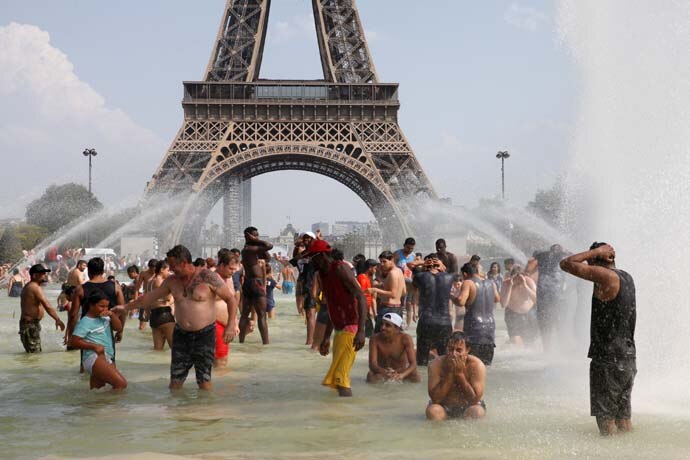 People cool off in the Trocadero fountains across from the Eiffel Tower in Paris as the second heatwave broke temperature records in France on July 25, 2019. (Photo: Reuters)
“Without the means to dissipate heat, our core temperature rises, irrespective of how much water we drink, how much shade we seek, or how much rest we take. Without respite, death follows – soonest for the very young, elderly or those with pre-existing medical conditions,” explains Dr Tom Matthews, a climate scientist at the Loughborough University, in his paper published in The Conversation.
Solution?
It is a catch-22 situation. On the one hand, the body needs external aids to cool itself down to survive. For this, the most common solution is air conditioning. However, air conditioning comes with its own set of problems. Using and producing air conditioning equipment further exacerbates climate change.
While you run the air conditioner, the primary refrigerant is the Hydrofluorocarbon or the HFC. This is known to be among the most potent greenhouse gases. When this is leaked into the atmosphere (and no, the leakage cannot be prevented) from the manufacturing of the equipment to the installation, to the disposal of old units, it furthers global warming.
Moreover, air conditioning units run on electricity that relies primarily on fossil fuels to generate power. Needless to say, that makes things worse.
If you choose to ignore all of this, imagine a situation when there will be a power outage. We are not hypothesizing, but talking of a very real situation as the power demands of the world are increasing beyond sustainable levels. In fact, reports suggest that by 2050, cooling systems are expected to increase electricity demand by an amount equivalent to the present capacity of the US, EU, and Japan combined. “Provided that electricity supplies can be maintained, living in chronically heat-stressed climates of the future may be viable. But with such dependence on this life-support system, a sustained power outage could be catastrophic,” writes Dr Matthews.
The only solution in sight, therefore, is slashing the greenhouse gases and living sustainably. We are already way behind nature’s schedule to contain the damage. Any further delay is nothing short of a catastrophe.


Comments
Post a Comment