Why Chennai’s water crisis is not surprising?
The city is reeling under the worst water crisis in 30 years.
Chennai is facing a drought for the third year in a row. The city went without a single drop of rain for about 200 days, the city had a brief shower last week. Too little and too late for a city that is experiencing its worst water crisis in 30 years.
The city’s primary water source — its groundwater has been tapped to the fullest. The four sources that replenish the groundwater — Red Hills Lake, Poondi reservoir, Sholavaram lake and Chembarambakkam tank, in addition to the water desalination plants at Nemelli and Minjur — are now dry. Against a total of 11.257 thousand million cubic feet (TMC) capacity, the four reservoirs supplying water to Chennai have less than 35mcft water left in store. The demand for water in the city has gone up by 47% in the last decade from 750 million litres per day (MLD) in 2008 to 1,100 MLD in 2018. In the same period, the metro water supply has come down by 8% from 650 MLD to 600 MLD.
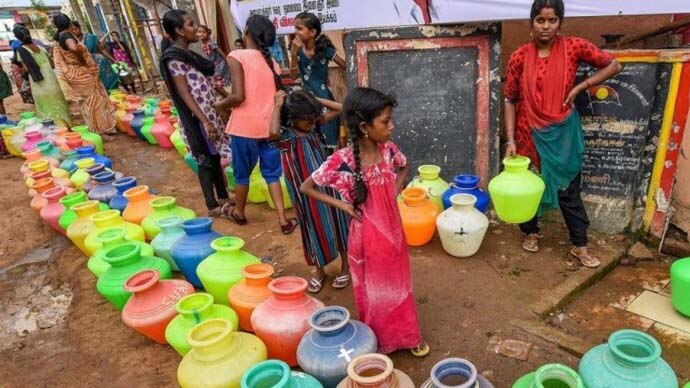 Dry taps, thirsty citizens: Residents gather to fill empty containers with water from a municipal tanker in Chennai (Photo: Reuters)
As of last week, the storage levels of Chennai's four reservoirs stands at 0.19% of their capacity. Groundwater levels have dropped drastically by over 300 feet. Borewell installation charges have increased by 150% as demand grows. The city is importing water from nearby towns like Jolarpet to fulfil the basic water needs. However, the measure cannot be a lasting solution owing to Jolarpet's own needs. In terms of water consumption, Chennai's per capita consumption is 107 litres per capita per day. This is much lower as compared to other cities that consume 140-270 per capita per day.
Then what went wrong?
For a city that does not have a perennial water source, Chennai has lost water bodies at an alarming rate in the past four decades. According to a 2016 study conducted by former engineers of the Tamil Nadu Public Works Department (Water Resources), lakes and ponds in the state have come down by thousands. Official PWD figures show there were no less than 39,202 lakes and ponds 40 years ago. Of these, due to a combination of factors like encroachment, lack of maintenance of the water bodies and unplanned development, most of them have been lost.
“Four decades ago, the full capacity of water across the state’s lakes was 390 TMC, but gradually, the levels have been going down to present levels of 250 TMC. This is an ominous signal that the state could face water scarcity,” the study had warned three years ago.
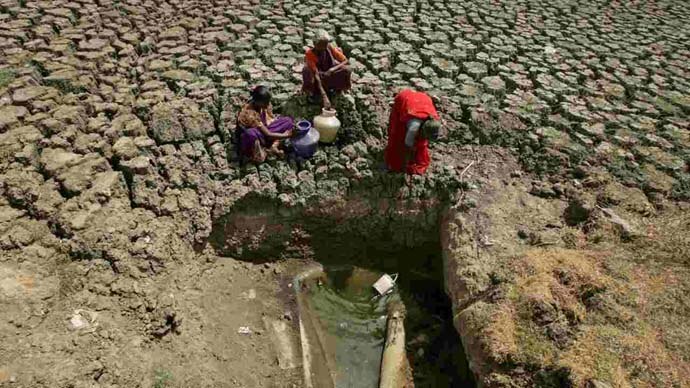 Parched: Women fetch water from an opening made by residents at a dried-up lake in Chennai (Photo: Reuters)
Next, only 5 out of 210 water bodies in the city have been restored, according to the affidavit filed by the Chief Engineer of the Chennai Metro Water Supply and Sewerage Board to the Madras High Court on the water scarcity. The efforts to restore and maintain the city’s tanks, reservoirs and lakes have been in the pipeline for the nearly a decade now. In fact, even the desilting of Chennai's reservoirs has not been carried out in over a decade
When the late Chief Minister J Jayalalithaa set a landmark ordinance on Rainwater Harvesting in Tamil Nadu in 2003, the order mandated that all buildings in Tamil Nadu fix rainwater harvesting structures immediately and store water. The late CM perhaps envisaged a drought-free state. However, over a decade and a half from then, the drought has worsened since the dry spell of 2001 to 2003.
The reason? Despite the excellent planning, the failure lies in its very poor implementation. According to a report in The News Minute, when the Chennai based NGO — Rain Centre conducted a rainwater harvesting survey in the greater Chennai region, it was found that government buildings were the worst violators of the rainwater harvesting rule. Ironically, Rain Centre did the audit on the government's insistence that a third party undertake it for the sake of autonomy. The survey went on to add that 52% of the structures surveyed did not have rainwater harvesting structures. With the state of affairs this poor, it is no doubt whatsoever that the water crisis in the state is purely man-made.
Despite the rains, floods and a sudden surge in water levels, the city is parched. Activists say that the solution to tackle drought and deluge is the same — to prioritise water over everything else by creating enough infrastructure for water to stay. “Unfortunately in Chennai, the developmental growth has trumped the water availability. Most places where the soil allows the water to either be stored or flow-through or percolate now have concrete structures and buildings on them. There is no way that the groundwater is replenished. The planning authorities must ensure that the water is able to seep into the ground. We need more lakes, tanks and ponds — the city must prioritise fallow and open spaces over concrete establishments," Activist Nithyanand Jayaram points out.
We couldn’t agree more.


Comments
Post a Comment