When Hope lost it all
Buying lipstick, or a pack of crisps? Remember that there are only around 13,400 Sumatran orangutans that remain in the wild.
She did not give up her home when those out to kill her, ripped her months-old baby from her. She did not give up her home even when she was shot 74 times. Even when the air-gun pellets pierced her eyes, blinding her, she felt her way up the tree trunks with her fingers searching out fruits for her sustenance. She did not give up her home because she had nowhere else to go.Her name, ironically, is Hope. She is a Sumatran orangutan. One of the thousands who are rendered homeless and killed in fulfilling our demands for everything from snack foods to soaps —everywhere palm oil is needed.
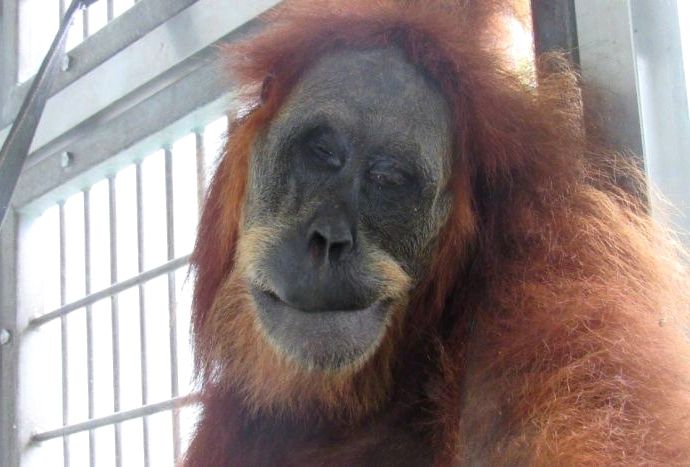 All Hope lost. It is unlikely Hope will be released back into the wild. It is unlikely that she will survive in the wild. (Photo: Twitter/ Indonesian Ministry of Environment and Forestry)
Orangutans are the most intelligent beings on the planet after human beings. In fact, the word “orangutan” means “people of the forest” in Malay. They are self-aware beings with an average intelligence of a 6-year-old human child. Like humans, they are known to adapt to the environment by passing on culture through each generation. And they die to meet our wants and ever-growing demands for consumer goods powered by palm oil. The palm plantations destroy their homes — in the past two decades alone, nearly 80% of orangutan habitat has disappeared. In the last 20 years alone, over 3.5 million hectares of Indonesian and Malaysian forest have been destroyed to make way for palm plantations. To put this in perspective, every hour forest land to the size of 300 football fields are being razed by either felling the trees or burning the forests down for clearing.
With their homes gone, the orangutans forage the plantations for food — primarily tropical fruits. And the farmers (who in turn are employed by large MNCs) treat them as vermin out there to destroy the crops. The stories of their horror killings include instances of being macheted to death or being burnt alive as an agricultural pest.
In a paper published last year, it was found that the world lost nearly 1,50,000 orangutans from the island of Borneo alone between 1999 and 2015 owing to deforestation and forest clearing for industrial plantations, and killing. It is on track to lose another 45,000 by 2050, the paper published in the journal Current Biology, said.
In the process of fulfilling our demands for prepackaged snacks and cosmetics, we are rendering at least 6,000 orangutans homeless every year or worse, killing them. That is more than 16 orangutans every day.
Where is palm oil?
Everywhere. Palm oil is the most widely consumed vegetable oil on the planet. It is more common than you think. It is found in products we millennials survive on, including bread, crisps, margarine, vegan cheese, soap and skincare products, ice cream, pizza bases, instant noodles, shampoo and even some chocolates.
 A few of the 74 bullets lodged in Hope in an X-Ray of her ribcage. (Photo: Facebook/ Sumatran Orangutan Conservation Programme)
Palm oil is branded and marketed cleverly as vegetable oil. Any product that contains any of the following in the ingredients is disguising its palm oil contents — vegetable oil, vegetable fat, palm kernel, palm kernel oil, palm fruit oil, palmate, palmitate, palmolein, glyceryl, stearate, stearic acid, elaeis guineensis, palmitic acid, palm stearine, palmitoyl oxostearamide, palmitoyl tetrapeptide-3, sodium laureth sulfate, sodium lauryl sulfate, sodium kernelate, sodium palm kernelate, sodium lauryl lactylate/sulphate, hyrated palm glycerides, etyl palmitate, octyl palmitate, palmityl alcohol.
Is it even possible to go off palm oil?
No, it is not. And neither should you boycott palm oil because avoiding palm oil could have worse effects as it takes away the support from companies that are trying hard to improve the situation. The solution lies — as with everything — in the sustainable production of palm oil. In fact, it is already the better oil for the environment as it takes less land to produce than other vegetable oils.
 A baby orangutan in Borneo, where the expansion of plantations is destroying their habitat (Photo: Greenpeace)
NGOs like Roundtable on Sustainable Palm Oil are known to work on sustainably producing palm oil by certifying products with the RSPO label. It essentially means that palm oil was produced in a socially and environmentally responsible way. However, these are not entirely trustworthy or transparent. The best way to do your bit is to try and find substitutes to palm oil — for instance, using coconut, groundnut, olive, mustard, sesame and other oils instead of palm oil for cooking.
A study by the International Union for the Conservation of Nature (IUCN) published in June 2018 found that in its current form, so-called sustainable palm oil is only marginally better than standard palm oil in terms of preventing deforestation. “When you consider the disastrous impacts of palm oil on biodiversity from a global perspective, there are no simple solutions. If we ban or boycott it, other, more land-hungry oils will likely take its place,” said the former director-general of IUCN — Inger Andersen.
The next time you order a pizza or dig into your instant noodles or flaunt that brand new “vegan” lipstick, remember Hope who is now in a shelter. Remember that she is hopeless to fulfil your fantasy.
Also read: The pangolin races against time even as humans spare no cruel efforts in making it extinct



Comments
Post a Comment